Appearance
Async Payments
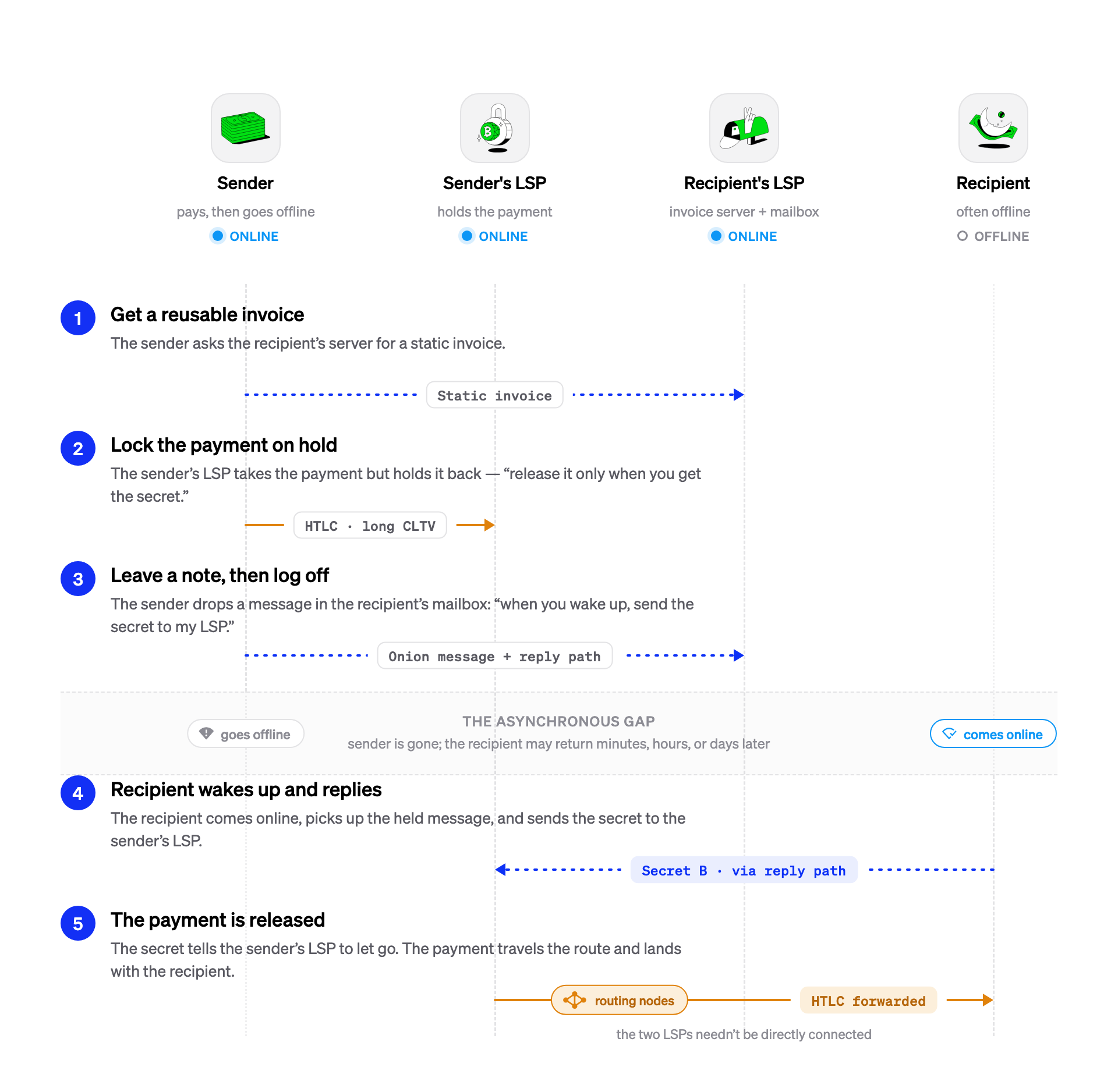
Async payments let an often-offline node — typically a mobile wallet — receive Lightning payments without keeping an app open in the foreground, without trusting a third party to custody funds, and without anyone encumbering network capacity with long-lived HTLCs.
Beta
Async payments are still under active development and are not yet recommended for production use. In particular, the sender-side HTLC hold — extending CLTVs so the sender's LSP can hold the payment until the recipient comes online (step 2, "Lock the payment on hold") — has not yet been merged. The flow currently works LDK-to-LDK only; interoperability with other Lightning implementations is not yet guaranteed, and the APIs described below may change before the feature is complete.
This guide covers how to enable async payments in your application. For the protocol background, the existing approaches it improves on, and the design rationale, see the blog post Async Payments: Getting Paid While Your Node Is Offline.
Integrating Async Payments
LDK handles the async offer machinery transparently once your node is configured for the appropriate role. The configuration differs depending on whether your node is an always-online participant, an often-offline sender or receiver, or the always-online LSP and static invoice server that supports offline recipients.
Always-Online Sender or Receiver
If your node is reliably online, no special configuration is required. Pay an offer with ChannelManager::pay_for_offer; async offers are handled transparently.
Often-Offline Sender or Receiver
For a node that is frequently offline, such as a mobile wallet:
- Set
UserConfig::enable_htlc_holdtotrue. - Obtain blinded paths to your static invoice server out-of-band from the LSP (see Acting as an LSP below).
- Register those paths with
ChannelManager::set_paths_to_static_invoice_server. - When sharing an offer with a sender, obtain it from
ChannelManager::get_async_receive_offer. - Pay offers with
ChannelManager::pay_for_offer; async offers are handled transparently.
Acting as an LSP / Static Invoice Server
An always-online node that serves offline recipients acts as both an onion message mailbox and a store for static invoices:
- Set
UserConfig::enable_htlc_holdtotrue. - Initialize the onion messenger with
OnionMessenger::new_with_offline_peer_interceptionso that messages destined for offline peers can be held. - Generate blinded paths for each recipient with
ChannelManager::blinded_paths_for_async_recipientand deliver them to the recipient out-of-band. - Act as an onion message mailbox by handling
Event::OnionMessageInterceptedandEvent::OnionMessagePeerConnected: buffer messages for offline peers, and flush them when the peer reconnects. - Persist static invoices by handling
Event::PersistStaticInvoice. Store the provided invoice and itsinvoice_request_pathkeyed by(recipient_id, invoice_slot), then callChannelManager::static_invoice_persistedwith the suppliedinvoice_persisted_path. - Serve invoice requests by handling
Event::StaticInvoiceRequested. Look up the persisted invoice and reply withChannelManager::respond_to_static_invoice_request.
For a complete reference on the events referenced above, see the Event documentation. For details on configuring and constructing the ChannelManager, see Setting up a ChannelManager.